The renewed attention around Magazine Dreams Film Themes has less to do with a single “moment” than with a long, public release story that kept the film in circulation as an object of debate rather than a settled entry in the calendar. The movie’s path—from a high-profile festival premiere to delays, a distributor change, and a later theatrical release—has functioned like a second narrative running alongside the onscreen one.
Magazine Dreams Film Themes now get discussed in the same breath as questions about performance, bodily transformation, and the kinds of characters American cinema still elevates or abandons. The film, written and directed by Elijah Bynum and led by Jonathan Majors as aspiring bodybuilder Killian Maddox, is built around a man chasing recognition while failing at ordinary connection. That tension—between visibility and loneliness—has proven sticky in culture talk, especially as fitness imagery and “self-optimization” language keeps expanding across everyday life.
There is also the plain fact of timing: a 2023 Sundance debut followed by a 2025 U.S. theatrical release created a prolonged period for commentary to accumulate before most audiences could even buy a ticket. Magazine Dreams Film Themes, in that sense, arrived already annotated.
The body as battleground
Discipline as identity
Magazine Dreams Film Themes start with a familiar American promise: if the work is total, the result will be undeniable. Killian Maddox is framed as someone who treats bodybuilding less as sport than as a full governing logic—his routine dictates how he eats, sleeps, speaks, and imagines a future. The film’s power comes from how quickly that devotion stops reading as “dedication” and starts reading as confinement.
What looks like discipline also functions like a substitute personality. The pursuit becomes the only stable language he trusts, and everything else—jobs, dates, even therapy—turns into a space where he is performing stability rather than living it. That split is not presented as a twist; it sits in the open, uncomfortable and repetitive in a way audiences recognize from real life.
In discussion, Magazine Dreams Film Themes often land on a blunt question: when a body becomes the résumé, what remains when the body fails. The film keeps returning to that risk without offering an elegant psychological answer.
The mirror economy
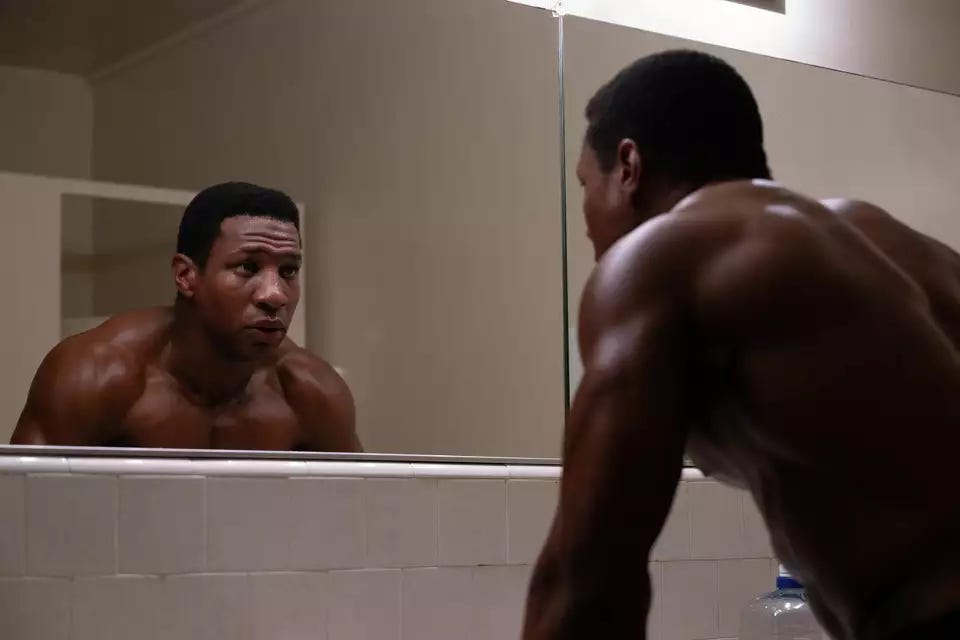
Magazine Dreams Film Themes operate inside a world where evaluation is constant and rarely compassionate. The bodybuilding setting makes that literal—judges, rankings, comparisons—but the movie’s sharper point is how the mirror becomes a daily court. Killian is described as living with body dysmorphic disorder, and the story treats perception as a kind of unstable evidence.
There’s a cultural familiarity here that goes beyond gyms. Mirrors are now pocket-sized and networked, and even people far from competitive sport learn to read themselves as projects: before-and-after, bulk-and-cut, “progress” measured in images. Magazine Dreams Film Themes fit into that climate because the film shows a character who cannot locate a neutral surface. The reflection is always an accusation.
The film’s social world reinforces it. Small interactions are loaded with ranking—who is seen, who is ignored, who is permitted to take up space. In that sense, the mirror is less an object than an institution, one Killian can’t resign from.
Steroids and physical cost
Magazine Dreams Film Themes don’t romanticize the price of transformation, and the film is explicit that steroids are part of Killian’s attempt to hold the line between ambition and collapse. The plot ties his drug use to physical ailments, folding bodily consequences back into the character’s emotional volatility. That matters because the story isn’t just “mind spiraling.” It’s physiology, appetite, sleep, and pain braided into mood.
The cultural discussion tends to sharpen at this point, because the steroid question refuses a clean moral frame. The film shows the incentives without delivering a tidy lecture: the body is the product, and the product has deadlines. Magazine Dreams Film Themes resonate here with broader sports conversations where enhancement is both taboo and an open secret, depending on who’s benefiting.
And there’s another discomfort: audiences are used to cinematic transformation as spectacle and awards-season trivia. Here, the transformation is a narrative pressure point—something that can’t be separated from harm.
Public judging, private collapse
Magazine Dreams Film Themes turn competition into a public ritual that quietly authorizes cruelty. One of the film’s key turns is a show where Killian is assaulted beforehand, still drives to compete, and then passes out on stage. The sequence matters less as plot mechanics than as an image of what it means to present “control” while losing it.
It also clarifies the movie’s view of institutions. The contest doesn’t stop; the environment doesn’t protect him; the crowd doesn’t become a community. The stage is a promise that attention will redeem suffering, and then the promise fails in real time. That collapse is part of why Magazine Dreams Film Themes are debated as something closer to tragedy than sports drama.
Discussion around the film often lingers on how ordinary the aftermath feels. After the spectacle, there isn’t a heroic regrouping. There is ice, a bathtub, and the dull continuation of obsession. It’s an anticlimax that reads like reportage.
Intimacy as transaction
Magazine Dreams Film Themes are also about the ways intimacy gets priced when someone doesn’t know how to ask for it. The plot includes a date with Jessie that derails when Killian unloads his past and then spirals into an intense monologue about his bodybuilding dreams, leaving her to walk out. The scene is socially legible: not villainy, not innocence—just miscalibration with consequences.
Later, the film places him with a sex worker and then in an ambiguous encounter with his idol, Brad Vanderhorn, a professional bodybuilder Killian has pursued through letters. Those moments aren’t framed as simple “sex scenes.” They’re framed as evidence of a person trying to purchase belonging, then panicking when the terms are real.
That’s where Magazine Dreams Film Themes start to feel less niche. Many viewers recognize the broader pattern: relationships treated as achievements, vulnerability treated as a negotiation, loneliness treated as something to outlift. The film doesn’t insist audiences sympathize, but it refuses to let them look away.
Violence and solitude in the American frame
Workplaces that don’t see you
Magazine Dreams Film Themes locate humiliation in ordinary settings rather than in grand catastrophe. Killian is a grocery store worker, and the job is presented less as background than as a daily reminder that his private self-concept has no public proof. The fluorescent normalcy of work becomes a kind of insult.
That choice also keeps the story from drifting into “exceptionalism.” This isn’t a prodigy trapped in a dramatic arena. It’s a person doing shift work, trying to build a myth in the margins. When he is eventually fired, the event reads as both practical and existential: not just lost income, but lost structure. The film suggests that modern loneliness is often administrative.
In cultural talk, Magazine Dreams Film Themes connect here with a wider unease about precarious life: jobs that consume time without delivering identity, and institutions that offer therapy language while leaving people materially and socially stranded. The film doesn’t solve that. It just shows the vacancy.
Letters to an idol
Magazine Dreams Film Themes sharpen when the story turns to fan mail—Killian writing letters to Brad Vanderhorn, trying to force a connection across hierarchy. The letters are not framed as cute devotion. They are framed as a strategy: if the right person acknowledges him, the rest of the world will follow.
The idea is culturally familiar. Contemporary fame invites parasocial closeness while keeping real access scarce. The film uses bodybuilding as the vehicle, but the dynamic is recognizable in music, influencers, athletes, actors—any figure whose image is both intimate and unreachable. Magazine Dreams Film Themes, in this strand, become about what happens when aspiration is routed through a single gatekeeper.
When Brad finally responds and invites Killian to a photo shoot, the relief is unstable from the start. The invitation doesn’t heal him; it merely changes the shape of the hunger. That’s part of the film’s grim accuracy about status: proximity can intensify longing rather than satisfy it.
A masculinity built from silence
Magazine Dreams Film Themes are steeped in a masculinity that speaks in measurements, not feelings. The character has recurring emotional outbursts and appears unable to express true emotions, while trying to “hide” what is happening inside him from his counselor. The film makes that concealment feel habitual, not strategic.
Silence becomes an aesthetic. It reads as toughness to outsiders and as containment to the person living it. But the story keeps showing the cost: when language is missing, the body becomes the only instrument left for expression—posing, flexing, bulking, enduring pain. Magazine Dreams Film Themes connect to a cultural moment where male vulnerability is frequently discussed but still socially punished in practice.
The movie also refuses a neat conversion narrative. Therapy exists, but it doesn’t function like a screenplay fix. The counselor’s office is another room where a performance is required. For some viewers, that lands as cynical. For others, it lands as closer to the public record of how change actually fails.
Race, visibility, and expectation
Magazine Dreams Film Themes are often read through the lens of visibility—who gets to be seen as complex, and what kinds of bodies are treated as threatening by default. The film is not structured as a thesis on race, but it places a Black lead inside a story about aggression, surveillance, and the craving to be recognized as more than a stereotype. That tension animates audience debate because it doesn’t resolve itself into comfort.
The film’s release context amplifies this discussion, too, because the lead performance was widely positioned as awards-caliber after Sundance, before later events shifted how the film was handled publicly. When a project is delayed and re-routed, the cultural conversation tends to fill the vacuum with interpretation.
Magazine Dreams Film Themes, in this view, become about how quickly a body can be turned into a symbol. The character is desperate to control what he signifies. The world keeps assigning meanings anyway. That push-and-pull is part of what makes the film feel contemporary even when it is operating in a relatively contained setting.
The thin line between fantasy and action
Magazine Dreams Film Themes rely on a frightening ambiguity: violent fantasy is shown as a daily weather system, not as an exceptional storm. The plot describes Killian buying and assembling guns, breaking into a judge’s home, and later attending Brad’s posing show armed, imagining a shooting before leaving without firing. The film’s interest is not shock. It’s proximity.
That proximity reflects a wider cultural discomfort about how violence lives in imagination long before it becomes action. The story suggests that fixation can be both theatrical and dangerously practical—daydreams that start to acquire logistics. Magazine Dreams Film Themes get debated here because the film refuses the easy distinction between “harmless” fantasy and “real” threat.
It also refuses catharsis. There is no clean punishment arc that reassures the audience the system works, and no triumphant rescue that reframes him as simply misunderstood. What remains is unease, and the sense that institutions notice a person only after the worst possibility becomes plausible.
Release history as cultural text
Sundance debut and early reception
Magazine Dreams Film Themes can’t be separated from how the film first entered public view. The movie premiered at the Sundance Film Festival on Jan. 20, 2023, and early coverage positioned it as a major showcase for its lead performance. That kind of festival launch creates a specific form of anticipation: prestige first, wide audience later.
Sundance also produced its own controversy around accessibility. The film’s premiere lacked an open-captioned print, and a captioning device provided to juror Marlee Matlin malfunctioned, leading jurors to walk out of the initial screening in support. Even that episode fed into later discussion about whose experience is centered at “important” cultural events.
From there, the film became a known quantity without being a seen one. Magazine Dreams Film Themes circulated through reviews, industry talk, and the aura of the “acquired” title. The result was a long runway for interpretation—sometimes serious, sometimes opportunistic—before the film’s eventual theatrical life.
The strike-era calendar shift
Magazine Dreams Film Themes also sit inside the practical chaos of the early-2020s release calendar. The film was originally slated for a Dec. 8, 2023 theatrical release by Searchlight Pictures, then removed from the schedule in October 2023 amid the SAG-AFTRA strike and controversies surrounding its star. Those are separate forces, but they collided in one decision.
That collision matters because it’s how movies become symbols. A delayed release is rarely just a delay; it becomes an argument about priorities, risk, and what a studio believes the public will tolerate. Magazine Dreams Film Themes became easier to talk about than the film itself, because the film was no longer simply “upcoming.” It was suspended.
The broader industry context did the rest. The strike period already had audiences thinking about labor, compensation, and who is protected. Into that atmosphere, a film about a man destroying himself for a dream started to look less like fiction and more like an allegory people could weaponize.
Legal context around the star
Magazine Dreams Film Themes are unavoidably entangled with the public legal story around Jonathan Majors, because that story materially affected the film’s distribution. Wikipedia’s release history notes that following Majors’ conviction for assault and harassment in December 2023, reporting suggested it was unlikely Searchlight would release the film. That is part of the public record of why the film’s trajectory changed.
The cultural argument often splits at this point. Some insist the performance must be discussed on its own terms, because the film is the work of many people and the character is not the actor. Others argue that a film’s meaning changes when the lead becomes associated with real-world harm, especially in a story already preoccupied with violence, control, and male rage. The film doesn’t provide the answer; the audience does.
What’s striking is how the delay turned the film into a test case. Magazine Dreams Film Themes became a proxy debate over “separating art from artist,” but also over how distribution choices function as soft power. The film’s very availability became part of its message.
A smaller distributor’s bet
Magazine Dreams Film Themes gained another layer when the film changed hands. The release history states that in January 2024 Searchlight returned the film rights to the filmmakers, and later, in October 2024, Briarcliff Entertainment acquired domestic distribution rights. Briarcliff then set the U.S. theatrical release for March 21, 2025.
That handoff shifted the frame from studio prestige to independent risk management. Smaller distributors often survive by betting on attention—sometimes because they believe in the work, sometimes because controversy guarantees conversation, often because the economics demand some form of heat. The film’s new release plan was read through that lens, fairly or not.
Magazine Dreams Film Themes, in other words, were no longer only about the character’s yearning for recognition. The movie itself was now seeking recognition through a narrower pipeline. That parallel is hard to ignore: a story about a man trying to break into a hierarchy, released by a company operating outside the most protected tier of the industry.
Box office and critical afterlife
Magazine Dreams Film Themes didn’t end at release, because the theatrical numbers and critical aggregates became part of the narrative. Wikipedia reports an opening weekend gross of $701,365, with the film later grossing $1,173,594 as of May 20, 2025. Those figures shaped perceptions about whether controversy translates into sustained audience demand.
The film’s aggregated critical response also became an easy shorthand. Wikipedia cites Rotten Tomatoes at 80% positive from 142 critics with an average rating of 7/10, and Metacritic at 65/100 based on 34 critics. Aggregates are blunt instruments, but they influence what gets remembered as “good,” “difficult,” or “not worth it.”
International rollout added another delayed beat. Wikipedia states the film was set for a U.K. release on Dec. 5, 2025 via BUFF Studios, the distribution arm of the British Urban Film Festival. The staggered timeline kept the conversation alive, region by region, long after the film should have been settled into the archive.
What the film prompts in 2026
Fitness culture after the algorithm
Magazine Dreams Film Themes feel newly relevant in 2026 because fitness culture has become less a subculture and more a default aesthetic. The “gym” is no longer a place you go; it’s an identity you broadcast, with progress staged as content and discipline treated as moral evidence. Against that backdrop, the film’s bodybuilding focus reads less like an extreme setting and more like a distilled version of common pressures.
The character’s obsession with becoming a Mr. Olympia champion is explicit in the film’s premise. But the broader idea—success as a visible surface—has spread widely enough that the film can be discussed without specialized knowledge of bodybuilding.
Magazine Dreams Film Themes also intersect with the way masculinity is packaged online: constant self-surveillance, constant comparison, constant talk of “grind” and “respect.” The film does not name algorithms, but it doesn’t have to. The mindset is already familiar to many viewers.
Mental health language, limited compassion
Magazine Dreams Film Themes push a hard question about what mental-health awareness actually changes. The plot describes Killian as mentally ill, living with body dysmorphic disorder, and attending counseling while withholding the darkest parts of his life. Therapy exists, but it doesn’t function as narrative rescue.
That rings true for a public that now speaks fluently about diagnoses while still struggling to respond to the people who carry them. Awareness can coexist with avoidance. Sometimes it even provides better euphemisms for the same old distance.
The film’s depiction of recurring emotional outbursts and isolation also complicates the easy social media posture of empathy. It’s easier to empathize with suffering that is polite, coherent, and safe. Magazine Dreams Film Themes keep circling suffering that is none of those things—suffering that frightens people, and therefore gets managed rather than met.
Audiences separating art and artist
Magazine Dreams Film Themes have become a frequent reference point in the continuing debate over whether audiences can—or should—separate a film from the conduct of its star. The distribution shifts, delays, and eventual release are publicly tied to controversies surrounding Jonathan Majors. That linkage made the movie a particularly charged object even for people who never saw it.
Some viewers approach the film as a collaborative artifact: writer-director, crew, supporting cast, and financiers are not reducible to one person’s choices. Others argue that the act of buying a ticket is not abstract; it is participation in an economy of attention and rehabilitation. The film’s subject matter—male rage, fixation, violence—sharpens the discomfort.
Magazine Dreams Film Themes persist because there is no final adjudication available to the public. Distribution is not a court ruling. Boycotts are not verdicts. What remains is a series of personal thresholds, argued out in public language that often pretends to be consistent but rarely is.
The sports movie turned inside out
Magazine Dreams Film Themes get traction because the film borrows the shell of a sports narrative and then refuses the expected emotional payout. It has training, competition, judging, an idol, and the dream of a title. What it withholds is the reassuring conversion of suffering into triumph.
That withholding repositions the bodybuilding world. Instead of community and mentorship, the story offers hierarchy and indifference. Instead of a clean rivalry, it offers obsession with a figure who can’t possibly carry the meaning assigned to him. Instead of “winning,” it offers a more corrosive question: what if the dream is the injury.
The film’s final movements, as described in the plot, turn away from spectacle and toward a quieter collapse and continuation—discarding a gun and steroids, returning to flexing in a garage, repeating the dream in voiceover. That ending is why Magazine Dreams Film Themes are discussed less like sports inspiration and more like a bleak character study.
A cautionary tale without closure
Magazine Dreams Film Themes continue to provoke because the story refuses to close the case. Killian’s actions escalate into threats and criminal intrusion, but the plot also shows him stepping back from an imagined worst act, leaving without shooting his idol. That choice doesn’t cleanse him. It simply prevents one outcome.
In public conversation, that ambiguity becomes the point. Many films about violence offer the audience either punishment or redemption as a kind of relief. Here, the relief is partial and unstable. The character’s breakdown in his grandfather’s arms reads as a human moment, but it doesn’t function as a guarantee of change. The next day still exists.
Magazine Dreams Film Themes, in the end, are less about bodybuilding than about a society that confuses attention with care. The film suggests that recognition is not the same as connection, and that “being seen” can be another form of pressure. It leaves viewers with the uncomfortable sense that the public record—of a person’s pain, a person’s danger—rarely resolves into a satisfying narrative.
The long release story keeps reinforcing that idea. Premiering in 2023, reaching U.S. theaters in 2025, and rolling into other markets later, the film has lived as a debate across multiple news cycles rather than as a single cultural event. That structure encourages projection: the movie becomes whatever the moment needs it to be.
Some questions are answerable on paper. The basic facts of its premiere, distributor change, and release are documented. The harder questions—how to weigh the work against the context around it, how to read a character like Killian without excusing him, how much empathy a culture can extend without endangering itself—remain open, and likely will.