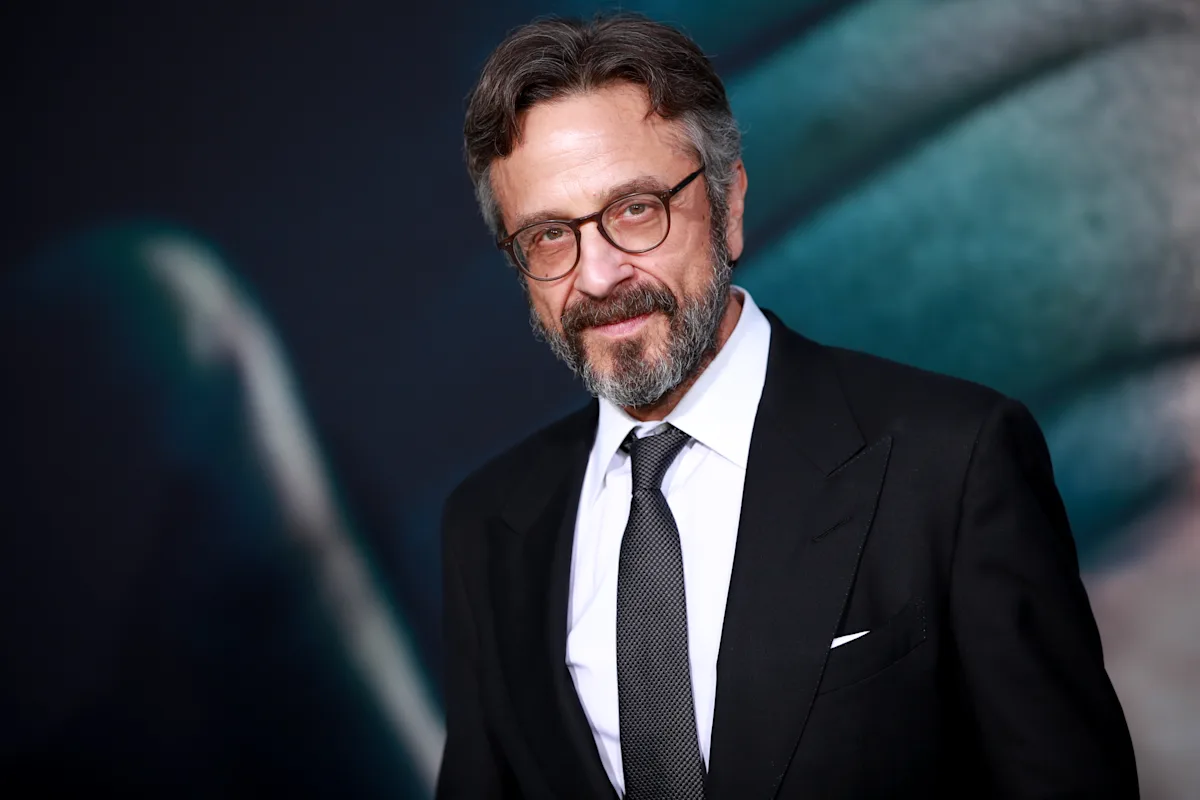
Marc Maron’s connection to the “Joker” story is often misremembered in casual retellings, but the public record is clear: he appears in the 2019 film “Joker” in a supporting role, not as the Joker himself. Fresh attention has followed Maron’s more recent on-mic recollections about what it felt like to be on that set, including details about watching Robert De Niro work through takes in ways Maron did not expect.
In the background is a larger, familiar cycle around “Joker” as a property: renewed conversation tends to arrive in waves—first around release windows, later around streaming, and then again when adjacent news (sequels, interviews, podcast clips) reintroduces earlier footage and supporting performances into the public stream. Maron’s name gets pulled into that churn partly because his screen time is compact but strategically placed, and partly because he has continued to speak publicly, in his own voice, about the film’s cultural temperature and about the people who made it. The result is a recurring question that seems simple but rarely stays that way: what, exactly, was the Marc Maron Joker role, and why does it keep coming up?
Where Maron fits onscreen
The role, as credited
Maron is credited in “Joker” as Gene Ufland, a producer on Murray Franklin’s talk show. That credit matters because it pins down what the role is—and isn’t—when later commentary blurs names, characters, and narrative function into shorthand. In “Joker,” Gene is not a costume, not a symbol, and not an alternate Joker figure; he is a working professional positioned inside the machinery of a broadcast set.
The easiest miscue comes from the way people talk about films colloquially: being “in Joker” becomes, in conversation, being “part of Joker.” That elasticity can be harmless until it starts to overwrite the basic cast record.
Gene Ufland’s job in the story
Gene Ufland is framed as a practical voice inside the studio environment, focused on what can go wrong when the show books a volatile guest. He isn’t presented as a moral narrator, and he isn’t written as a detective or authority figure; he’s the person who has to manage a live-production risk with incomplete information.
That “middle layer” is part of what makes the character memorable. Viewers may not remember his name, but they remember the texture: the producer’s alarm, the backstage friction, the sense that the room is trying to keep a segment upright while the larger narrative tilts toward catastrophe.
The scene that anchors him
One of the cleanest public anchors for Maron’s character is the backstage exchange involving Arthur Fleck, Murray Franklin, and Gene Ufland. In the NPR interview transcript about the film, the scene is introduced explicitly as “the producer played by Marc Maron” opposite De Niro and Joaquin Phoenix. The excerpt also captures Gene’s concern about audience reaction and the choice to put Arthur on anyway.
It’s a short stretch of screen time, but it sits close to the film’s pivot. That proximity is why the performance stays in circulation when people revisit clips, quotes, and plot summaries.
Why “Joker role” gets misused
The phrase “Marc Maron Joker role” persists because it collapses two different ideas: “role in the film Joker” and “role as the Joker.” The first is accurate; the second is not supported by the cast record. That slippage is more likely when a film title is also a character’s name, and when the surrounding discourse prizes speed over specificity.
A smaller factor is that “Joker” has become a kind of cultural noun—invoked to signal a mood, a debate, or a controversy. Once that happens, supporting parts can get dragged into the headline shape of the title.
What the film does with him
Gene’s function is not to deepen Arthur through friendship or mentorship, but to situate Arthur inside a media pipeline that can convert humiliation into spectacle. The moment also lets the film show multiple forms of discomfort at once: not just Arthur’s instability, but the staff’s dawning awareness that “good television” can collide with basic safety.
Maron plays that discomfort without turning it theatrical. That restraint—almost bureaucratic—can read as unusually “real” for a movie that is otherwise stylized, and that contrast is part of why people keep singling the character out years later.
The stories that revived attention
The De Niro anecdote resurfaces
A recent wave of renewed attention followed Maron’s recollection that, on the “Joker” set, he watched Robert De Niro repeatedly forget lines during a scene. In the same account, Maron describes the experience as “totally demystifying,” precisely because he had grown up watching De Niro’s work with near-mythic reverence. He also recalls thinking, in the moment, “This is a disaster,” before recognizing how much faith experienced actors place in editing and coverage.
That kind of behind-the-scenes detail travels because it’s specific, not promotional, and slightly destabilizing. It doesn’t flatter anyone outright, which gives it the ring of an unvarnished set memory.
Why that detail sticks
The anecdote doesn’t change the film’s text, but it changes how some listeners picture the craft behind it. Maron’s point wasn’t that De Niro was incapable; it was that De Niro understood, from long repetition, that imperfect fragments can still cut together into something seamless. For audiences trained to equate greatness with effortless mastery, that is a jolt.
It also reframes Maron’s own presence in the scene. Instead of being a comedian visiting a dramatic set, he becomes a working observer—someone watching the work happen, minute by minute, from close range.
Podcast context matters
The Wrap account ties Maron’s recollection to a conversation on his “WTF” podcast with actor Jason Ritter. That framing matters because it signals the tone: this wasn’t an awards-season panel or a studio featurette; it was a long-form talk in which tangents and craft talk can surface naturally.
Long-form audio has a particular effect on film narratives. It can make small roles feel larger because the actor has space to describe everything that surrounded the moment—waiting, watching, doubts, and the mundane logistics that never reach the screen.
Other small-role recollections orbit the film
The same Wrap piece notes another performer’s behind-the-scenes account: comedian Sam Morril, who appears briefly in “Joker,” said he used his own jokes and expected the production assumed he might “suck.” That kind of anecdote clusters with Maron’s because both are about comedians entering a film that carries heavy cultural baggage, then encountering a professional environment that is less mystical than outsiders imagine.
Taken together, these stories keep “Joker” in conversation without needing new footage. The film becomes a set of repeatable memories—portable, quotable, and easy to retell.
What gets lost in retelling
The more these anecdotes travel, the more the details compress. The nuance—Gene Ufland as producer, not host; Maron as supporting player, not lead—can flatten into a single noisy phrase, the kind that makes “Marc Maron Joker role” sound like a question about the character rather than the credit line.
That doesn’t mean the public is careless so much as it is consistent: audiences tend to remember the emotional headline of a story and discard the filing information. Film discourse runs on that trade.
Commentary around “Joker,” then and now
Maron on violence fears
Ahead of the film’s release, Maron addressed the swirling concerns that “Joker” might inspire violence, pushing back on the idea that movies themselves “cause” that outcome. In IndieWire’s summary of his remarks on “WTF,” he criticizes the obsessive attention around those fears and argues that anger can’t simply be assigned to a film as its landing spot.
Whether one agrees with the framing or not, the significance is that Maron didn’t treat his involvement as a reason to stay quiet. His participation in the movie didn’t convert him into a studio spokesman.
The Todd Phillips “woke culture” dispute
Maron also publicly disagreed with director Todd Phillips’ comments about comedy and “woke culture,” calling that line of thinking a tired refrain and arguing that plenty of people are still “really” funny. That disagreement was covered as a notable split: an actor in the film criticizing the director’s broader cultural diagnosis rather than defending it.
This is part of why the Marc Maron Joker role keeps being discussed as “context,” not just casting. He exists in the public record both as a participant and as a critic, and those positions don’t always align neatly.
Earlier remarks on why he took the part
In a 2019 write-up of Maron discussing the project before release, he acknowledged having been judgmental about comic-book movies, while also admitting the practical seduction of being offered a scene opposite De Niro and Phoenix. In the same account, he describes Phillips’ approach as closer to an “origin story” and “character study” than what he associated with the genre’s mainstream.
That tension—skepticism, then participation—has staying power. It gives journalists and fans a ready-made narrative hook, one that can be revived anytime “Joker” returns to the news cycle.
The NPR transcript captures his onscreen tone
For readers who want the cleanest record of what the role actually does, the NPR transcript excerpt is unusually helpful because it ties Maron directly to lines spoken as Gene Ufland in the backstage sequence. It also shows the character’s posture: cautious, doubtful, and focused on consequences rather than comedy.
That matters when later commentary turns the film into an argument about message. Maron’s character is not written as an ideological mouthpiece; he’s written as staff trying to keep a studio from being swallowed by a guest’s volatility.
Why the discourse keeps looping
“Joker” is the kind of film that people return to when they want to re-litigate older debates about media, responsibility, and spectacle. Maron’s public remarks about the surrounding hysteria, and his willingness to challenge Phillips on comedy culture, keep him attached to those debates even when the conversation is no longer about the plot.
That is the quieter driver behind the Marc Maron Joker role question: it’s less “Who did he play?” than “What did he represent at the time—and what does he represent now?”
The role’s lasting imprint
A supporting part with strategic placement
Maron’s performance isn’t designed to be the film’s emotional center, but it lands in a corridor of the story that viewers revisit: the talk-show pipeline that leads into the climax. Supporting roles placed near a narrative turn often age differently than ones scattered earlier; they become stitched to the memory of “what happens next.”
That’s also why the name confusion persists. When the title character’s final act is the thing most widely recalled, everything adjacent can be mislabeled as part of “the Joker role,” even when it is structurally something else.
The “media workplace” realism
Gene Ufland reads, in that NPR excerpt, like an actual producer worrying about audience blowback and segment control. That workplace realism is a particular flavor inside “Joker,” which otherwise often leans into heightened dread and isolating subjectivity.
It’s a small touch, but it gives the film a hinge to ordinary life. When audiences argue over what the film “says,” they often seize on such hinges—moments where the story brushes up against recognizable institutions: television, policing, social services.
Maron’s voice offscreen affects the memory
Because Maron is a known interviewer and monologist outside the film, his later retellings have unusual reach for a supporting performer. When he describes watching De Niro repeat takes, he’s not offering trivia; he’s shaping a listener’s mental image of how that “Joker” scene was manufactured.
That’s a different kind of authorship. The film remains Phillips’ and Phoenix’s in credit terms, but the afterlife of the film—what it feels like to remember it—is partly written by the people who keep talking.
How confusion becomes part of the story
A misphrased question can become a recurring myth. The longer “Marc Maron Joker role” circulates as shorthand, the more it risks suggesting he played the Joker rather than appearing in “Joker.” Yet the myth also signals something true: audiences noticed him enough to keep reaching for his name years later.
That’s not a compliment or a critique. It’s an observation about how film memory works, especially for movies that continue to operate as cultural reference points beyond their release window.
What’s still unresolved in public terms
Some aspects of “Joker” remain permanently interpretive—what viewers take from it, what it “means,” what responsibility sits where. But the factual spine around Maron is comparatively stable: his credited role, the scene’s placement, and his own public comments about the discourse are all available in the record.
The unresolved portion is more human than factual: how much a short performance can define a participant’s relationship to a controversial film, and how often that relationship has to be renegotiated as the film’s reputation changes shape.
Maron’s “Joker” presence is, in the credits, straightforward: he plays Gene Ufland, a talk-show producer, in a film where the Joker is portrayed by Joaquin Phoenix. The complication enters later, when the film’s afterlife pulls supporting players into larger arguments and the language people use—“the Joker role,” “in Joker,” “part of Joker”—starts doing too much work. Add in Maron’s own habit of speaking plainly in public forums, and the topic stays combustible in a low, persistent way: he will revisit the set, revisit the debate, revisit the people, and those revisits become news pegs.
The public record resolves the casting question cleanly, but it does not resolve the more slippery issue of ownership—who gets to define what “Joker” became in culture, and which participants are allowed to criticize the machine they briefly helped operate. For now, the Marc Maron Joker role remains a useful lens because it sits at the intersection of credit lines and commentary: a small onscreen job that keeps generating offscreen narrative. The next time “Joker” cycles back into attention, that intersection will still be there, waiting to be paraphrased—accurately, or not.