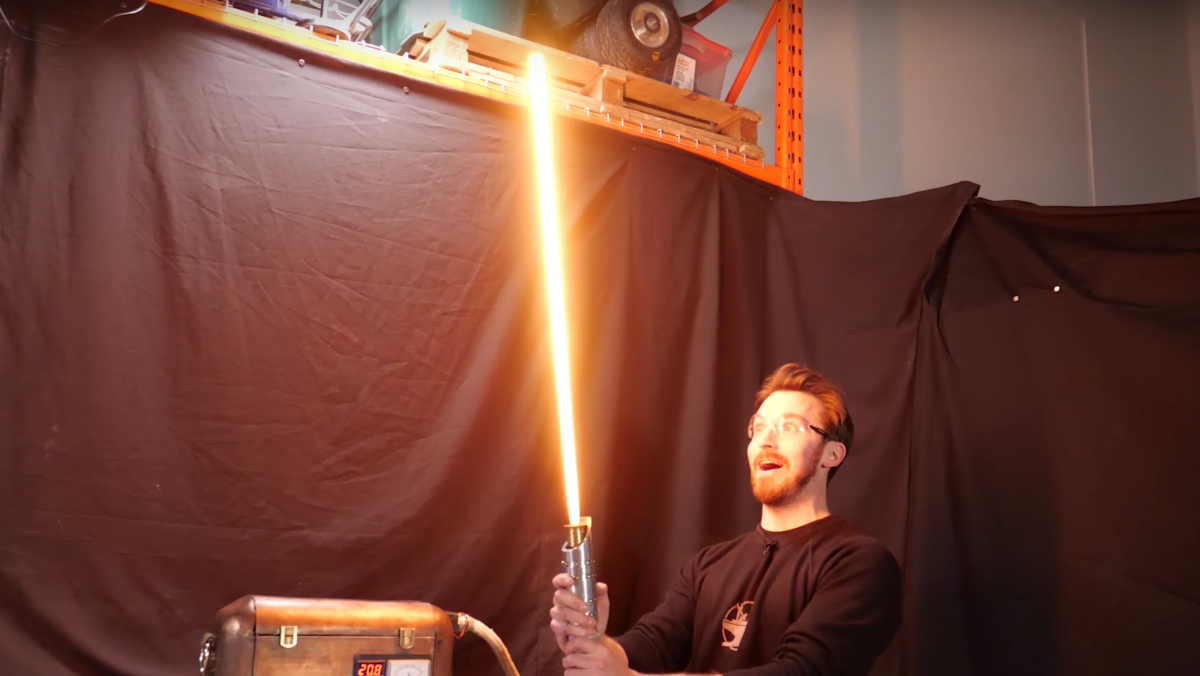
ProtoSaber Tool Capabilities And Technology has moved back into wider technical conversation after fresh circulation of build footage and anniversary-style reposts tied to the Hacksmith Industries protosaber work, including later “making-of” packaging that revisits earlier high-voltage design choices. It is being discussed now less as a fandom prop than as a compact case study in extreme power delivery, heat management, and control logic under constraints that are easy to see on camera and hard to solve in hardware.
Public record also anchors the project beyond social media churn: Guinness World Records credits Hacksmith Industries with the first retractable proto-lightsaber, created in Kitchener, Ontario, with the record entry dated October 2020 and the creation date cited as September 2020. That dual framing—spectacle on one side, documented engineering milestone on the other—shapes how ProtoSaber Tool Capabilities And Technology is now being referenced by builders, educators, and safety-minded engineers.
Public record and claims
A prototype with a timestamp
ProtoSaber Tool Capabilities And Technology sits in an unusual category: the design is demonstrative, but parts of its existence are fixed in formalized public record through a Guinness World Records entry naming Hacksmith Industries and identifying Kitchener, Ontario as the location. The entry’s timeline matters because it separates a one-off viral build from an effort that was at least stable enough to be presented as “first retractable” within a defined period. Even then, “retractable” is doing most of the work; what the record establishes is attribution and basic chronology, not the detailed performance envelope or how repeatable the mechanism is across builds.
In practical terms, that leaves a familiar gap. The public can point to a date and a team, but the deeper questions—duty cycle, service life, failure modes—remain mostly distributed across videos, clips, and secondary write-ups that were not created as test reports.
Why “tool” language stuck
Calling it a tool is not just rhetorical. The early framing leans on the “protosaber” concept as a tethered system with an external pack, which is closer to industrial reality than the self-contained sci‑fi handle. That matters because ProtoSaber Tool Capabilities And Technology becomes legible as a platform: energy storage off-body, a controlled high-energy working end in-hand, and a control interface that has to handle mistakes.
Once described that way, it starts to resemble other real equipment—cutters, heaters, torches—where the user’s reach and line-of-fire are separate from the largest risks. The name then stops being a joke and becomes a shorthand for an engineering compromise: accept bulk elsewhere to make the handheld portion usable.
Documentation in fragments
The best-known technical specifics in circulation are not in datasheets; they are spoken, shown, or briefly captioned. In the 2019 build video, the team describes battery pack construction, pack weight, and switching choices while the camera stays close enough to show connectors, meters, and enclosure layout. In later repackaged “making-of” material, the emphasis shifts to the blade concept—wire-wrapped heated element, ceramic insulation, and the consequences of a switch that does not switch off cleanly.
ProtoSaber Tool Capabilities And Technology, as a result, is “documented” in a way engineers recognize from real life: enough to understand the idea, not enough to replicate safely without doing substantial original work.
The value of visible failure
The record is clean; the build process is not. One reason the project keeps resurfacing is that it shows failure as part of the artifact—components burning, switching not behaving as expected, and the team pivoting from MOSFET attempts toward a contactor-like approach. The 2017-era “making-of” clip also foregrounds the safety posture on set—kill methods, insulated gloves, staged extinguishers—while still showing that unexpected behavior can show up at activation.
That visibility drives discussion because it reduces the temptation to mythologize the device as solved technology. ProtoSaber Tool Capabilities And Technology becomes a public example of how quickly control problems become safety problems when energy density rises.
What the public record does not settle
Guinness naming answers the “who” question but not the “how well” question. The videos answer some “how” questions but do not establish standardized benchmarks, and they are not presented as independent verification. That leaves interpretive space where confident claims circulate—often about temperatures, cutting ability, or run time—without a shared method of measurement.
ProtoSaber Tool Capabilities And Technology therefore functions as a reference object rather than a reference specification. It is discussed constantly, but it is not fully defined.
Hardware stack and constraints
Power delivery as the core story
The 2019 video’s most telling moments are not the cuts; they are the electrical admissions. The team describes a system that, in their own framing, is dominated by current draw and switching difficulty—so much so that conventional switch hardware is treated as non-viable for the load. They describe battery packs built from 18650 lithium-ion cells arranged to deliver high current, and later describe a completed pack totaling 24 volts and 80 amp-hours.
ProtoSaber Tool Capabilities And Technology, at its center, is a power electronics problem disguised as a prop build. The “blade” is downstream of the harder task: delivering energy controllably, repeatedly, and in a package a person can wear.
Switching: the unglamorous bottleneck
A recurring theme is that turning something on is easy compared with turning it off. In the 2017-era clip, the system is operated at elevated DC voltage with explicit concern about safety, and an apparent switching failure is described in plain language when the device behaves as though it remains on. The 2019 build revisits this at higher ambition, describing MOSFET failure and then moving toward a “giant electromagnetic switch” approach via a contactor.
This is where ProtoSaber Tool Capabilities And Technology starts to look like industrial equipment design: it is less about a single component’s capability and more about system behavior under fault, including what happens when a control element fails closed.
Blade concepts: heat as the “working end”
The 2017-era clip frames the blade as a stainless rod wrapped in ceramic insulation and then wrapped with Kanthal wire to function as a heating element under power. It also states an operating temperature figure for Kanthal and ties the observed ignition behavior to simple contact. In the 2019 build, the “blade” is treated as something that can be upgraded—thicker tungsten, titanium pipe—after earlier damage.
ProtoSaber Tool Capabilities And Technology, in this formulation, is not a “light” device but a controlled hot object. That matters because it sets realistic boundaries: the blade does not need to defeat physics by containing plasma; it needs to deliver heat where the user points it.
Mechanical packaging: wearable energy
The tethered-power framing requires mechanical discipline: cable management, connector robustness, and a pack that can be carried without shifting into the user’s body during motion. The 2019 video explicitly frames the pack as wearable, emphasizes its weight, and shows the inclusion of meters and a large connector as part of the interface between pack and handheld unit. It also describes the pack as “heavy,” with a quoted pack weight in the low‑40‑pound range during the build sequence.
ProtoSaber Tool Capabilities And Technology becomes partly an ergonomics story—how the energy system is made portable without making the user immobile or the connector path hazardous.
Controls and instrumentation
The 2019 build includes visible instrumentation—ammeter, volt meter, mode indicators—presented as part of the operational posture rather than decorative elements. That is significant because the device is not treated as a black box; it is treated as something that may need monitoring mid-use, which is a tell about uncertainty and risk. In the same narrative, the team speaks about wiring hazards inside the enclosure and the need to keep certain conductive parts from contacting each other.
ProtoSaber Tool Capabilities And Technology, as a platform, therefore implies an operator who is at least partly a technician. The system invites observation because ignoring its state is not a safe default.
Demonstrated capabilities and limits
Cutting and ignition: what video can show
In the 2019 build, the team explicitly states that the device can cut through things and then demonstrates ignition-by-contact behavior while describing the blade as extremely hot. The 2017-era clip similarly ties observed ignition to temperature and contact, emphasizing that materials with less mass yield more easily. Those demonstrations are persuasive because they are visual, but they are also narrow: they show that heat transfer is rapid, not that the tool is universally effective across materials or thicknesses.
ProtoSaber Tool Capabilities And Technology, in the public imagination, is “a cutter,” but what is actually established on camera is closer to “a high-heat contact tool with dramatic ignition potential.”
Retraction as a systems problem
The Guinness entry’s headline attribute is retractability, and it connects that feature to the Hacksmith Industries team rather than a generic category of builds. Retraction is not just a flourish; it implies control of a high-energy working end during motion and transition states—deploying, stowing, and handling partial extension. Even when the public does not see the full internal mechanism, the fact that retractability is the definitional claim puts attention on actuation, timing, and interlocks.
ProtoSaber Tool Capabilities And Technology discussions often dwell on what the blade is made of, but retractability pulls focus to what moves and what must stay stable while moving.
Sound, sensors, and the “experience layer”
A quieter but instructive element appears in the 2017-era clip: the mention of a sound module with an IMU so that motion triggers effects associated with swinging. That shows the build as layered—core energy system plus an experience system—where the latter can be developed using consumer-grade electronics even if the former is extreme. The 2019 video also gestures toward a similar intent by talking about making it “sound like one,” even while the build focus remains power handling.
ProtoSaber Tool Capabilities And Technology, viewed this way, is a hybrid product: an industrial-risk core with a hobby-electronics interface, which is partly why it attracts such a wide range of commentary.
Safety posture shown on camera
The 2017-era “making-of” clip explicitly describes safety precautions: CO2 fire extinguisher presence, a “rip cord” concept to cut power, and insulated gloves for the operator. The 2019 build similarly includes repeated verbal emphasis on “safety first,” visible caution around wiring, and references to preventing catastrophic shorts. None of this transforms the build into a certified system, but it does establish that the builders themselves framed the hazard as central, not incidental.
ProtoSaber Tool Capabilities And Technology is often treated online as a daring stunt. The footage, by contrast, repeatedly treats it as a controlled hazard—managed, but never domesticated.
The limits: what it is not
Even in the enthusiastic framing, the 2019 video calls the result “the world’s most inefficient vaporizer,” a line that inadvertently underscores the inefficiency of turning stored electrical energy into spectacle heat in open air. The 2017-era clip also implies durability limits by acknowledging the blade design is not as robust as hoped and describing the need for redesign. These admissions matter because they bound expectations: the device is not a practical replacement for industrial cutting tools in ordinary settings, and it is not a safe dueling object.
ProtoSaber Tool Capabilities And Technology has real outputs, but it also has real constraints that show up quickly: weight, fragility under stress, and the unforgiving nature of uncontrolled heat.
Technology applications and spillover
A public case study in high-current design
ProtoSaber Tool Capabilities And Technology has become a shortcut example for high-current decision-making in a way textbooks rarely manage. The 2019 video’s narrative—MOSFET trouble, migration toward a contactor, attention to inrush and fault states—reads like a condensed lesson in why component selection is never just about peak ratings. Engineers watching do not need to agree with every choice to recognize the category of problems: switching under load, thermal runaway, fault containment, and human-interface clarity.
The spillover application is pedagogical. It is easier to teach power-system humility with an object people already care about, especially when the footage is frank about what went wrong.
Materials and thermal management as transferable thinking
The blade construction described in the 2017-era clip—metal core, ceramic insulation, resistive wire—maps to industrial heating concepts, scaled into a handheld narrative. The 2019 build’s move toward tougher materials and revised structures after damage echoes a standard engineering loop: prototype, fail, reinforce, and repeat. Even without formal test data, the visible iterative material choices help frame how thermal tools evolve, particularly when heat has to be concentrated without destroying the carrier structure.
ProtoSaber Tool Capabilities And Technology, in that sense, functions as a public demonstration of thermal design tradeoffs rather than a singular “blade recipe.”
Control interfaces that assume imperfect users
One under-discussed implication is that the device’s interface is built for uncertainty. The 2019 pack includes meters and indicators, and the build narrative treats operator awareness as part of the safety model. The 2017-era clip’s kill-cord framing is also an explicit acknowledgment that “stop” must exist outside the primary control path. These are not ornamental choices; they are design decisions that show up across hazardous tools, from industrial heaters to robotics.
ProtoSaber Tool Capabilities And Technology becomes a reference point for a particular philosophy: if a failure can happen, plan for it in hardware, not in hope.
Regulatory and liability gravity
The project’s public visibility creates a different kind of application: it becomes a stress test for how platforms, brands, and institutions respond to dangerous builds circulating as entertainment. The creators themselves include explicit warnings in published video descriptions, framing content as entertainment and discouraging recreation. That does not settle liability questions in general, but it does show awareness that the audience includes people who may be tempted to replicate what they see.
ProtoSaber Tool Capabilities And Technology therefore sits at an awkward intersection—educational by accident, hazardous by nature, and widely accessible in presentation even when not accessible in execution.
What comes next remains partly unknowable
Later clip packaging in 2025 indicates the project’s continued afterlife, including recaps that reference very high power claims and the practical reality that failures can escalate quickly. Guinness recognition fixes one milestone, but it does not fix the trajectory; there is no single public document establishing a definitive “final version” with stable specifications. That uncertainty keeps the discussion open, especially as adjacent builds—fuel-based “plasma” concepts, different retraction methods, alternative power storage—continue to circulate across maker media.
ProtoSaber Tool Capabilities And Technology is likely to remain a moving target: less a finished device than a recurring prompt to ask what “portable high energy” can realistically mean.
Conclusion
ProtoSaber Tool Capabilities And Technology has ended up bigger than the object itself, largely because it occupies two worlds at once: the world of documented spectacle and the world of stubborn engineering limits that refuse to be edited out. Guinness’s entry establishes a clean attribution and a timeline for a retractable proto-lightsaber credited to Hacksmith Industries in Canada, which gives the story a formal anchor that viral projects rarely earn. The footage, meanwhile, supplies the messier record—power delivery challenges, switching failures, material revisions, and a safety posture that suggests the builders understood the risks as intrinsic rather than theatrical.
What the public record still does not resolve is the question people tend to smuggle in: whether the device is “practical” in any everyday sense. The demonstrations show heat, ignition, and the reality that a wearable power system can drive a handheld thermal tool, but they do not establish standardized performance claims across materials, environments, or repeated duty cycles. That gap is not a flaw in the story; it is the story. If ProtoSaber Tool Capabilities And Technology continues to be referenced, it will likely be as a visible boundary line—what can be made to work once, what can be made to work repeatedly, and what still has no clean answer when the camera stops rolling.