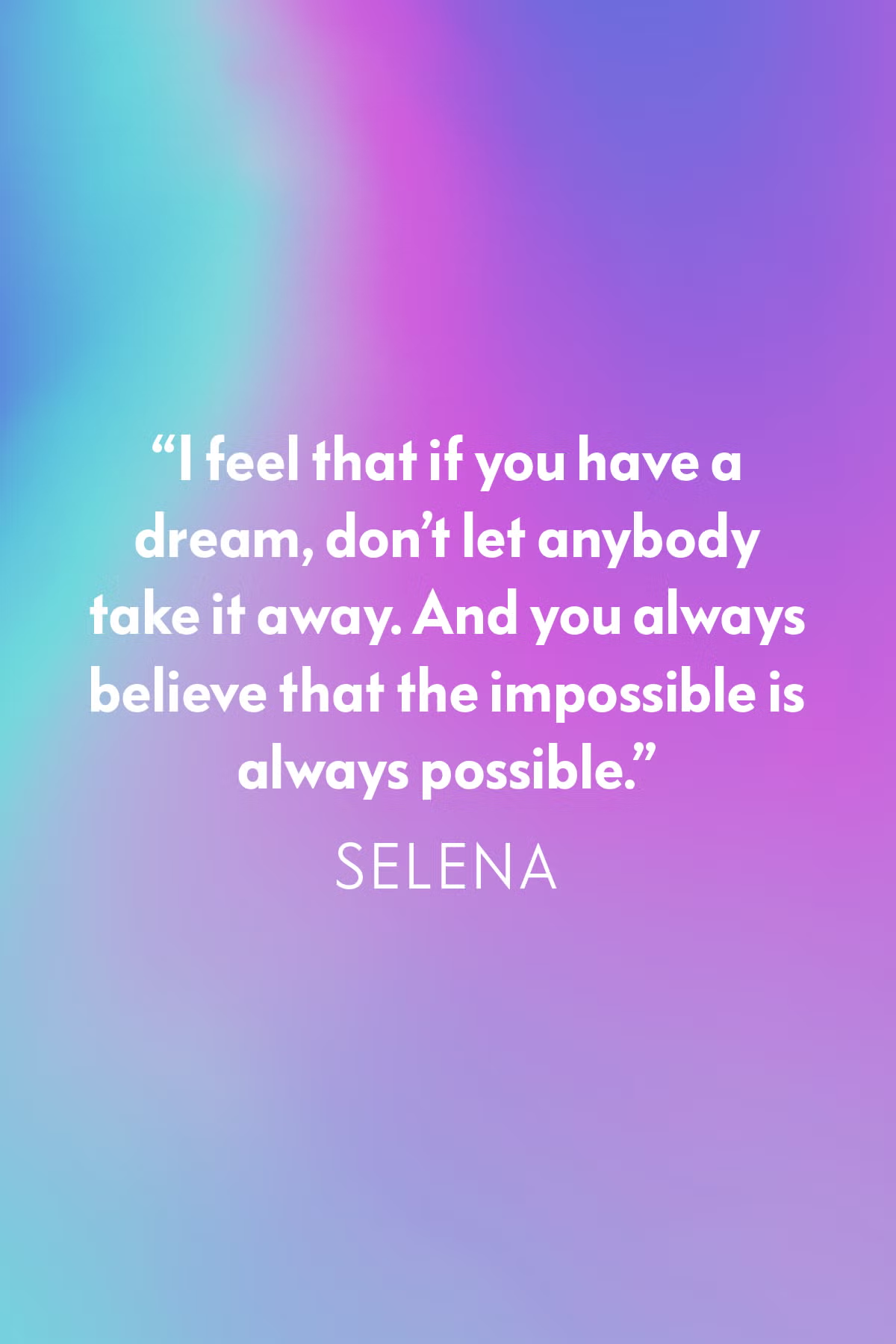
In early 2026, Selena’s voice is being heard again in a different register—through short, repeatable lines that travel easily across exhibits, screenings, and public remembrance. The phrase “Selena Quintanilla quotes inspire fans” fits the moment because the renewed attention isn’t only about her recordings; it’s about how her own comments, preserved in interviews and family-approved posts, still organize how people talk about ambition, identity, and responsibility.
The timing is not abstract. A major museum exhibition in Los Angeles is bringing Selena’s personal items into a new public setting, billed as the first official display of artifacts outside the Selena Museum in Corpus Christi. Netflix has also promoted a family-backed documentary, built around previously unseen material from the Quintanilla archive, which adds another round of mainstream framing to familiar footage and lines. Against that backdrop, “Selena Quintanilla quotes inspire fans” has become less a slogan than a working shorthand—one that lets admirers argue about what she actually said, when she said it, and why certain sentences keep getting pulled forward.
Fresh reasons these words resurface
A museum setting changes the texture
A quote reads differently when it’s absorbed in a gallery, surrounded by wardrobe, sketches, and the physical evidence of routine. The GRAMMY Museum’s “Selena: From Texas To The World” is scheduled to run from Jan. 15 to March 16, 2026, bringing personal items into a formal exhibition context in Los Angeles. That kind of setting tends to privilege short, declarative statements—things that can sit beside an object without needing a narrator.
In that environment, “Selena Quintanilla quotes inspire fans” stops being a caption and starts acting like interpretive glue. Visitors don’t need a deep discography to understand a line about work, education, or self-definition. The display does some of the persuading on its own: sequins, travel, labor, repetition.
A documentary reframes familiar footage
Netflix’s “Selena y Los Dinos” has been promoted as a documentary drawing on previously unseen footage from the Quintanilla family’s private collection, with Selena’s siblings participating as producers. That promise—new material from a controlled archive—almost guarantees that older interview lines will be replayed, re-contextualized, and compared against what audiences thought they knew.
That is often when quotations spike in public life: not when they’re new, but when they’re reintroduced with fresh authority. “Selena Quintanilla quotes inspire fans” becomes a convenient way to talk about the documentary without litigating every editorial choice. People quote to stake a claim, then argue about what the claim should mean.
The calendar keeps reopening the story
Selena’s public anniversaries arrive with predictable force. The dates prompt local programming, small tributes, and media packages that pull from the same limited set of taped interviews. That repetition has an unintended effect: it turns certain lines into fixtures, the way a chorus becomes the part that outlives the verse.
In that cycle, “Selena Quintanilla quotes inspire fans” persists because it describes a practice more than a mood. Fans don’t just listen; they retrieve, repeat, and test the words against current pressures. The calendar doesn’t settle anything. It keeps asking the same questions again.
Regional celebrations keep the quotes in motion
Selena tributes are often staged as music-first events, but the spoken lines travel alongside the songs—on flyers, on stage intros, in announcements, in brief community speeches. When people gather for an artist who died young, the appetite for direct language grows. A sentence that sounds decisive can feel like a shared script.
The result is that “Selena Quintanilla quotes inspire fans” becomes literal: the words are part of the ritual of gathering. They’re used to bridge generations, or to offer something sturdier than nostalgia. Even when no one agrees on interpretation, repetition itself signals belonging.
Archival interviews keep producing “new” material
Selena’s interview record is not endless, which is part of why certain phrases keep returning. A small body of taped material gets re-cut, re-captioned, translated, and clipped into short segments that circulate as standalone statements. Context thins out. The line remains.
That’s why “Selena Quintanilla quotes inspire fans” can sound both obvious and newly urgent at the same time. The quote becomes a portable unit, detached from the moment it was spoken. And then, paradoxically, people go looking for the original moment again.
Work, discipline, education
“When you get hard work you get success”
One of Selena’s most-circulated lines is blunt enough to survive any format: “When you get hard work you get success.” It reads like a motto, but it also reads like a defense—something said by a performer who had already been categorized as luck, novelty, or marketing.
The phrasing matters. It doesn’t promise ease, and it doesn’t flatter the listener. That may be why “Selena Quintanilla quotes inspire fans” so often returns to this sentence: it lets admirers talk about effort without dressing it up as destiny.
In public retellings, the line functions as proof that talent alone wasn’t the story. It’s also a reminder that even visible success can carry a memory of being dismissed.
“Music is not a very stable business… your education stays”
Selena’s education line keeps resurfacing because it contains two truths at once: glamour is real, and it’s unreliable. “Music is not a very stable business… But your education stays with you for the rest of your life,” she said in an interview quotation preserved in public compilations.
It’s a striking statement from a young star, and it complicates the myth that artists must choose between school and vocation. “Selena Quintanilla quotes inspire fans” often lands here because the quote is practical—almost parental—without sounding like a lecture.
The line also hints at what fame can’t guarantee. People repeat it when they want ambition to sound responsible, not reckless.
“We got laughed at… it’s a gradual growing process”
Another recurring point in the record is how long the climb took and how openly the group was doubted. Selena described early resistance and slow progress: “We got laughed at… It’s a gradual growing process, it’s not like it came overnight.”
That sentence has become a counterweight to modern overnight narratives. “Selena Quintanilla quotes inspire fans” partly because it gives language to the unphotographed years—the small gigs, the quiet refusals, the stretch of time when confidence has no audience.
It also locates success in accumulation, not revelation. That framing feels particularly durable in industries that reward spectacle but run on repetition.
“We went through a hard time… no regrets”
Selena’s comments about hardship avoid melodrama, which makes them easier to trust. In a publicly circulated quote, she describes turning to music to put food on the table and ends with a clean verdict: “No regrets either.”
There’s no attempt to manufacture tragedy. The line implies routine strain, not mythology. For many listeners, “Selena Quintanilla quotes inspire fans” because her phrasing sounds like someone speaking from experience rather than branding.
The sentence also leaves space for contradiction—hard time, but not bitterness. That’s often what people want from a quote: permission to hold two truths without resolving them.
“You have to take what you could get when you’re getting started”
This line is less famous, but it carries the texture of real work: “You have to take what you could get when you’re getting started.” It’s not inspirational in the poster sense. It’s logistical.
That’s precisely why it lasts. “Selena Quintanilla quotes inspire fans” because some of her most useful statements sound like backstage talk—what someone says when the cameras are gone but the schedule remains.
The quote also punctures the idea of a pure career path. It acknowledges compromise without glamorizing it, which can feel like solidarity to people building something with limited leverage.
Public image and identity
“Yo soy muy natural… muy honesta”
In a Spanish-language interview excerpt preserved in public collections, Selena is quoted describing herself as “muy natural… muy sencilla… muy honesta,” with an English sense rendered as being real, sincere, and honest. The line is repeated because it speaks directly to image-making, the central pressure of pop stardom.
There’s a reason “Selena Quintanilla quotes inspire fans” often leans on this statement. It frames authenticity not as a brand attribute but as a decision—something she claims she will keep doing.
The quote also sits at the intersection of language and identity. The Spanish matters, not as decoration, but as a cue about audience and belonging.
“It’s never too late to get in touch with your roots”
Another Spanish-language line attributed to Selena is quoted as pride in being Mexican and a frank admission about not learning Spanish early, followed by the conclusion: “it’s never too late to get in touch with your roots.” It’s widely repeated because it speaks to a common diaspora tension without punishment.
“Selena Quintanilla quotes inspire fans” here because the line doesn’t pretend the struggle is solved. It acknowledges a gap—language, access, time—and then refuses to treat the gap as permanent.
In public life, that stance becomes a kind of permission. People cite it when they’re trying to re-enter culture without being asked to prove they deserve it.
“The most important… accept me for my music”
Selena is quoted emphasizing that acceptance should center on the music rather than physical appearance: “The most important is that the people accept me for my music, not for physical appearances.” The sentence continues to travel because it’s a clear statement of priority, not a vague call for confidence.
It also reads as an observation about the industry’s scrutiny—especially for women—without needing to name every mechanism. “Selena Quintanilla quotes inspire fans” because the line offers a boundary, and boundaries are often what people borrow from public figures.
The quote has also aged into new contexts. It’s cited in debates about branding, body commentary, and what audiences think they’re entitled to judge.
“I don’t see myself that way”
A telling moment survives in accounts of Selena reacting to celebrity attention after a major awards season, saying it was “really cool” when others got excited but adding, “I don’t see myself that way.” The line is small, almost offhand, which is why it lands.
It suggests a kind of distance between public status and private self-concept. “Selena Quintanilla quotes inspire fans” because humility, when it doesn’t sound performative, becomes a usable language for navigating praise.
There’s also something unsettled in it. The statement doesn’t declare that fame is meaningless. It simply admits that the internal image can lag behind the external one.
“Anybody can be a role model”
Selena is quoted saying, “Anybody can be a role model. Anybody can.” It’s repeated because it flips the hierarchy. Instead of claiming exceptional status, it disperses responsibility outward.
For admirers, “Selena Quintanilla quotes inspire fans” because this line refuses the usual celebrity arrangement. It doesn’t ask for worship. It asks for replication—ordinary people taking ownership of how they’re seen by others.
At the same time, the quote can feel demanding. If anybody can be a role model, then nobody gets to opt out. That tension—comforting and pressuring—helps explain why the sentence keeps being retrieved.
How fans use the quotes
“Be a leader not a follower… the impossible is always possible”
A line circulated via Selena’s official channels, in a family-approved remembrance post, includes the directive: “be a leader not a follower,” paired with “the impossible is always possible.” It functions like a distilled manifesto, designed for easy repetition.
“Selena Quintanilla quotes inspire fans” in this form because the quote has institutional backing; it’s presented as part of a curated legacy. That doesn’t end debates about wording, but it does give the line a stamp that many admirers treat as authoritative.
The phrasing also shows how Selena’s public memory gets maintained. Not only through songs, but through selected sentences that stand in for a worldview.
“The reason I’m really appreciative… I never expected it”
Selena is quoted describing gratitude as a discipline: she said she was appreciative because she “never expected it” and wanted to keep that attitude. The line continues to circulate because it offers a way to talk about success without claiming it was inevitable.
It also quietly rejects entitlement. “Selena Quintanilla quotes inspire fans” here because admiration is often tangled with resentment—who got a chance, who didn’t, who stayed grounded. This sentence gives people a clean narrative: recognition arrived, but surprise remained.
Still, the quote doesn’t sanitize ambition. It doesn’t say she didn’t want more. It says she didn’t want to lose a certain posture while pursuing it.
“When I am singing I am a completely different person”
Selena is quoted describing performance as a kind of transformation: “When I am singing I am a completely different person… I could be very free.” Fans return to this line because it captures something many performers recognize but struggle to explain.
“Selena Quintanilla quotes inspire fans” because the sentence can be read in multiple directions. For some, it’s about stage confidence. For others, it’s about the partition between public body and private mind.
The quote also complicates simplistic authenticity talk. If she becomes a different person while singing, then “real” is not a single fixed state. That ambiguity, rather than a tidy message, is often what makes a quote feel true.
“I want to be remembered… as a person who cared”
In an interview excerpt, Selena is quoted saying she hoped to be remembered not only as an entertainer but as someone who cared and tried to help and be a role model. It’s a long sentence, almost breathless, and it doesn’t read like a polished line.
That is part of why it persists. “Selena Quintanilla quotes inspire fans” because the quote sounds like a person talking under pressure, not a brand delivering a mission statement.
It also places moral weight on remembrance without dictating how others must mourn. The quote asks for a certain kind of memory, but it doesn’t claim control over it. Public memory, as her story shows, never fully cooperates.
“You shouldn’t care… just because of materialistic things”
Selena is quoted rejecting materialism as a basis for love: “You shouldn’t care for somebody just because of the materialistic things that they have.” Fans repeat it because it’s direct, and because it arrives from someone whose career was surrounded by visible consumption—fashion, touring, media, spectacle.
“Selena Quintanilla quotes inspire fans” here because the sentence reads as a personal standard, not a general condemnation. It’s about what she says she believes, not what she demands from everyone else.
The quote also survives because it’s usable in ordinary life. It doesn’t require celebrity context. It works in relationships, family disputes, and the quiet accounting people do when they’re deciding what matters.
Selena’s quotations endure because the public record is simultaneously rich and incomplete: rich enough to show patterns in how she talked about work, humility, and identity, incomplete enough that every clip still feels contested at the edges. The new exhibition cycle in Los Angeles adds a physical frame to words that already circulate in fragments, while the documentary rollout promises fresh archival context without guaranteeing final answers about intention or emphasis. That tension is part of the engine. When “Selena Quintanilla quotes inspire fans,” it is not always because the lines are universally agreed upon; it is often because they are brief, sturdy, and adaptable to circumstances Selena never lived to see.
Some sentences read like advice she meant to give; others sound like quick self-protection in an interview chair. A few are so frequently repeated that they start to feel inevitable, as if they were always destined to become captions. But the record still has limits: short clips, translated phrases, reposted remembrances, and the selective memory of media packages. Even with family-approved projects, the story stays partly unresolved—what gets preserved, what gets emphasized, what gets left to fan narration.
In 2026, the most revealing fact may be that the quotes keep moving. They do not settle into one definitive meaning. They surface where Selena’s image is being actively curated, and where it is being actively argued over, too.