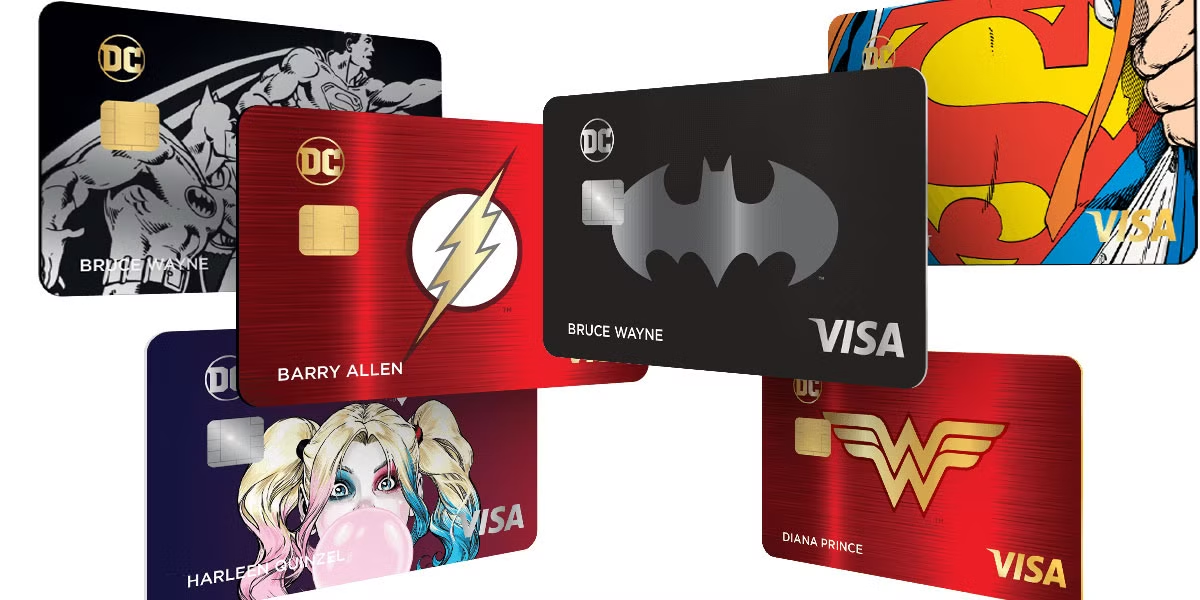
The DC Power Visa application has resurfaced in cardholder discussions as fans and credit-card shoppers compare niche rewards products with mainstream cash-back and travel cards, and as older card launches continue to circulate through community recommendations and warnings. What is publicly established is straightforward: this is a DC-branded Visa credit card serviced by UMB Bank, promoted around entertainment spending and DC-themed perks, and presented with multiple character card designs.
The questions that keep reappearing are narrower than the branding. People want to know what “eligibility” really means in practice, how the application is handled, what gets checked, and what happens after an approval or denial—especially when a product’s marketing is heavy on fandom and light on plain-language underwriting detail. The DC Power Visa application sits at that intersection: a standard consumer credit decision wrapped in a collector-facing package, with rewards rules and fee terms that still govern it like any other bank-issued card.
What the card is
A branded card with a bank behind it
The DC Power Visa is presented publicly as a DC-branded credit card, but the operating reality is a bank-issued Visa account with DC intellectual property layered on top. That distinction matters because “eligibility” ultimately tracks bank criteria and consumer-credit law, not fandom status or membership in a fan community. The most visible DC-facing elements—card art, themed discounts, and a reward portal—do not alter the core mechanics of how applications are evaluated.
Servicing has been described publicly as running through UMB Bank, a detail repeated in entertainment coverage and card summaries. In practical terms, that points applicants toward a conventional bank workflow: identity verification, credit bureau review, and terms delivery that look like other U.S. consumer cards. The branding may be the hook, but underwriting is the gate.
Rewards positioning influences who applies
Public descriptions of the DC Power Visa emphasize points for entertainment purchases, plus elevated earnings for dining and gas. That positioning shapes the applicant pool: not just comic readers, but households that spend heavily on streaming, cinema, and everyday categories that can be coded consistently by merchants. The rewards pitch is also a reason the same questions recur. Category bonuses can sound broad while operating narrowly in real transactions.
The card’s marketing leans into “where you already spend,” and that can create mismatched expectations when applicants later parse what counts as entertainment. A person applying primarily for the theme may miss that the economics are still driven by rates, fees, and whether a balance is carried. The eligibility discussion often arrives after that realization—sometimes too late.
Custom designs as part of the application moment
One of the card’s defining public features is the ability to choose among multiple DC designs, including a Batman-themed limited edition referenced in coverage. The design choice is framed as part of the application experience, which adds a consumer-product feel that is uncommon in plain bank cards. It can also create urgency, particularly when limited-edition artwork is involved.
But the design element does not signal pre-approval or improve odds. It is a personalization step, not a screening step, even if it appears early in the funnel. Coverage has described several character options and the broader appeal of selecting a preferred front-of-card image during signup. The underwriting still happens offstage.
Publicly stated bonuses and the fine print reality
Public summaries have described a sign-up incentive tied to spending within a defined time window, including a Fandango code alongside bonus points after meeting the threshold. That kind of offer tends to drive applications in waves, because it reads like an immediate payoff. It also becomes a source of frustration when timing, fulfillment, or merchant coding diverges from what a consumer assumed at the moment of application.
Coverage has also described points being redeemable for statement credits and other options, alongside DC-themed “experiences” promoted through the rewards portal concept. Those redemption paths can be real value, or marketing gloss, depending on what is actually obtainable at typical point totals. The eligibility conversation often shifts here—from “can I get approved” to “is it worth having.”
The “Visa” name confusion
The card’s name can trip readers who encounter it out of context. “Visa” here refers to the payment network on a consumer credit card, not an immigration document, and the application process is a credit application rather than a consular filing. That confusion is not just semantic; it changes what “eligibility” means. The relevant criteria are creditworthiness, identity verification, and bank policy.
Once the product is placed correctly—as a U.S. consumer credit card—the rest of the questions become familiar: which credit profile clears the hurdle, what income or housing fields are required, and how quickly a decision arrives. Those specifics are not always spelled out in promotional coverage, which leaves applicants relying on third-party summaries and community anecdotes.
Eligibility and underwriting
Creditworthiness drives the decision
Publicly available card summaries describe an APR range that varies “based on creditworthiness,” language that signals risk-based pricing and a credit-screening model rather than a single fixed rate. That phrasing is standard in U.S. consumer credit, but it is also a tell: applicants are being segmented, and borderline profiles may be approved on less favorable terms or declined outright. Eligibility, in other words, is not one bar. It is a ladder.
In practice, creditworthiness is a composite: score bands, utilization, delinquency history, recent inquiries, and the stability signals embedded in a credit file. The application may feel fandom-adjacent, but the decision is typically machine-assisted and policy-bound. The absence of a publicly stated “minimum score” leaves room for speculation, which is why forum threads tend to fill in the gap with personal outcomes.
Identity verification is not optional
A DC-themed card still triggers the same compliance requirements as any bank-issued consumer credit product. Applicants should expect identity questions, address history checks, and potential follow-up if automated verification fails. That can include document requests, but it can also be resolved through out-of-wallet questions or internal bank methods, depending on the case.
The eligibility impact is simple: a strong credit profile can still stall if identity cannot be verified quickly. This tends to catch applicants who recently moved, use nonstandard address formats, or have credit files that do not match current records. When applicants describe “pending” statuses in community discussions, the underlying issue is often verification friction rather than a pure credit decline.
Income and affordability are assessed, even quietly
The DC Power Visa application, like most U.S. credit applications, requires an income figure and housing information because banks are expected to consider ability to repay. That does not mean the bank demands pay stubs in every case, but it does mean the income field is not decorative. Applicants who treat it casually can create mismatches that later trigger review.
Eligibility is also shaped by the bank’s view of existing obligations. Two applicants with the same score can receive different outcomes if one has high revolving balances or thin remaining capacity. This is where “eligibility” becomes situational, and why the same product can produce dramatically different credit lines. The art on the card doesn’t change the math.
Age, residency, and basic applicant status
A consumer credit card is not open-ended in who can apply. Standard baseline requirements typically include being of legal age and having the legal capacity to contract, plus a verifiable U.S. address and Social Security number or other acceptable taxpayer identification. Those are ordinary constraints, but they matter for applicants outside the typical U.S. consumer profile, including students and recent arrivals.
Public card descriptions focus on rewards rather than these fundamentals, so some applicants only learn the boundaries after starting the process. Eligibility problems at this level can look abrupt: an application that cannot be completed, or a quick denial without much narrative. It is less dramatic than it feels. It is policy.
The role of existing bank relationships
Applicants often assume a co-branded card works like a store card with softer approval because the theme is niche and the audience is enthusiastic. But the servicing bank may not treat it as a “starter” product. Where a person banks, and whether they already have accounts with the issuer, can influence verification ease and sometimes risk perception, though issuers rarely frame it that way publicly.
Community discussion tends to translate this into folklore: “they like thick files,” “they’re inquiry-sensitive,” “they want existing customers.” None of that is publicly declared as a rule for this card. The safer reading is narrower: eligibility is governed by the bank’s standard consumer underwriting, and applicants should expect that posture regardless of branding.
Application process mechanics
The front-end: choosing, filling, submitting
Coverage has pointed applicants to an official application site and describes selecting from multiple card faces as part of the sign-up flow. Beyond that, the front-end resembles a typical bank card application: personal details, contact information, income and housing fields, and the legal consents that allow credit checks and disclosures. The look may be DC, but the fields are familiar.
The point that matters for applicants is sequence. People can become anchored to the design choice and treat the rest like paperwork, when the rest is the actual application. A single typo in address history can trigger verification delays, and a mismatched income entry can create downstream questions. The “application process” is mostly about data accuracy, not fandom preference.
Credit bureau pull and the decision window
Submitting a credit card application typically authorizes a credit bureau inquiry, and issuers often make an instant decision when policy thresholds are met. When an application goes to “pending,” it can signal manual review, identity verification needs, or policy exceptions. Applicants often interpret pending as a soft no. It isn’t always. It can be a request for time.
Community posts about the DC Power Visa have reflected the usual mix of outcomes: quick approvals, denials, and cases that require follow-up. The common denominator is that the process is not unique to the brand. It behaves like a mainstream credit product funnel with a themed wrapper. The uncertainty is normal, even if it feels personal.
What “eligibility” looks like in application language
The card’s published pricing has been described in terms that tie the APR range to creditworthiness. That language is effectively the public-facing summary of eligibility: the bank expects variation in who qualifies and at what cost. Applicants sometimes hunt for a bright-line rule. The documents usually avoid giving one.
Instead, the application experience tends to communicate eligibility indirectly through outcomes: approval with a credit limit, approval with a lower limit and higher APR, a request for verification, or a denial with an adverse action notice. Those are the real signals. Eligibility is not a checkbox; it is an underwriting classification.
Documentation and follow-up contacts
When an application is flagged, the follow-up can involve phone calls, secure messages, or mailed notices. The bank may ask for identity documents or additional confirmation of information already provided. Applicants often share the frustration of being asked to “prove” what was entered, but that is a standard control in consumer lending.
The practical implication is simple: the application process does not necessarily end when the submit button is hit. For some applicants, that is where it begins. The applicants who move smoothly through are the ones whose credit file, address history, and identity signals align cleanly. That alignment is invisible—until it isn’t.
Approval logistics: account opening and delivery
Once approved, the account is opened under the bank’s servicing structure, and the card is produced and shipped. Coverage has emphasized that the product is “serviced by UMB Bank,” which suggests that statements, payments, and support channels follow that bank’s systems rather than a DC entertainment platform. For applicants, that means the relationship quickly stops feeling like a fan product and starts feeling like any other credit line.
Timing varies, and it is usually not the most important risk. The more consequential piece is the terms package: the APR assigned, fee schedule, and how rewards are tracked. If an applicant applied for the design and did not read the account terms carefully, the surprises arrive later—often as interest charges or missed bonus conditions.
Terms, perks, and the post-approval reality
Rates and fees: the part that doesn’t wear a cape
Public card summaries have listed a variable purchase APR range and other fee terms, including balance transfer and cash advance pricing. Those are not background details; they are the structural cost of carrying the card. The DC theme can make the product feel “special,” but the economics are blunt. Anyone who carries a balance is interacting primarily with the rate, not the artwork.
The same summaries have noted no annual fee, which is often used as a reassurance point for applicants who want the card primarily as a collector object. But “no annual fee” is not “no cost.” Late fees, interest, and foreign transaction charges can still define the experience, especially if the account is used irregularly.
Bonus eligibility and fulfillment expectations
The publicly described bonus—points and a Fandango code after meeting a spending threshold within the first 90 days—creates a clear post-approval checklist in people’s minds. What tends to be less visible is the fulfillment cadence and what counts as eligible spending. That is where disappointment often forms: the bonus arrives later than expected, or a purchase category does not code the way a consumer assumed.
This is also where reporting restraint matters. There is no single public record that covers every edge case of merchant classification or bonus timing. What can be said is narrower: the offer has been described publicly with a spending threshold and a time window, and cardholders should expect the issuer’s systems—not the marketing copy—to determine compliance.
Category earnings and merchant coding disputes
Card descriptions have emphasized 3X points on entertainment and 2X on dining and gas, with 1X elsewhere. The lived experience depends on merchant coding, and coding can be unintuitive—especially for digital services bundled through third parties or billed through app stores. Consumers can believe they are buying “entertainment” and still receive base points if the merchant is coded differently.
This is not unique to the DC Power Visa; it is an industry-wide feature of rewards cards. But the branding can sharpen the frustration because the marketing implies a tight match between a fan’s spending and the card’s bonus structure. The gap between implied and processed categories is where complaints are born, and why card owners end up swapping notes in public threads.
DC-themed discounts and how they are applied
Public coverage has described DC-themed perks through the rewards structure, including discounts on DC-related subscriptions and purchases, and Warner Bros. Studio Tour Hollywood benefits. Third-party card summaries have described these discounts in more operational terms, including statement-credit style application for certain subscription discounts and exclusions on merchandise categories. Those details matter because they convert a vague “perk” into something with conditions.
The post-approval reality is that perks behave like contracts. They can be valuable, but they come with carve-outs, expiration timelines, and redemption mechanics. A consumer who applies expecting automatic discounts may find that some benefits require enrollment, codes, or specific payment methods. The gap between perk promise and perk execution is often where enthusiasm cools.
Redemption: what points turn into
Public descriptions have said points can be redeemed for statement credits, travel, experiences, gift cards, merchandise, and entertainment options. Third-party summaries have framed redemption through an “UltimateHero Rewards” portal model, with both standard redemptions and DC-themed “experiences.” That setup can be appealing, but it places the value question inside a catalog rather than a simple cash-back formula.
For applicants, this loops back to eligibility in a different way. Approval is not the only hurdle; extracting value is the ongoing test. A person can be approved easily and still end up with a low-value pattern if their spending doesn’t land in the intended categories or if they rarely redeem. The product is built to reward a certain life pattern, not just a fandom identity.
Conclusion
The DC Power Visa application looks, on the surface, like a branded entry point into the DC universe. The public record points to something more ordinary beneath it: a UMB-serviced Visa credit card with a rewards pitch centered on entertainment and a menu of DC-themed perks and designs. That dual identity is why “eligibility” remains a recurring question. People come for the artwork or the promise of fan-facing benefits, then discover the decision and the long-term cost are dictated by credit policy, pricing ranges tied to creditworthiness, and the unglamorous disciplines of repayment and merchant coding.
There is also a limit to what can be settled from public material. Coverage and summaries describe bonuses, categories, and redemption pathways, but they do not publish a single, definitive eligibility threshold or an approval formula. Community anecdotes fill the void, yet those remain personal snapshots, not a standard. For now, the DC Power Visa application continues to function as a conventional underwriting event wearing a collector skin—appealing, occasionally confusing, and subject to the same shifting risk appetite that governs any issuer’s portfolio. The unanswered part is not whether it is “real,” but how long niche co-branded cards like this can hold attention as rewards competition tightens and banks keep rewriting what they will, and won’t, approve.